
11+ Practice
11+ nets of cubes: how to use opposite faces and corner meets
Solve 11+ cube net and 3D spatial reasoning questions fast by listing the three opposite-face pairs first and checking how faces meet at a corner.
To solve an 11+ cube-net question without trying to fold the whole net in your head, write down the three pairs of opposite faces first and eliminate every 3D cube that shows two opposite faces at the same time. Because a 3D drawing of a cube shows three faces that all touch at one corner, two opposite faces can never be visible together in the same view.
In 11+ Non-Verbal Reasoning and Spatial Reasoning sections, cube nets test 3D visualisation under time pressure [1] . Children who try to fold all six squares mentally often lose track of which way a symbol points after the second fold. Using opposite-face pairs first usually eliminates three or four wrong options in a few seconds, leaving at most one corner or orientation check.
Step-by-step method
1. Find the three opposite-face pairs using the skip-one rule
Every cube has six faces, which fold into three opposite pairs. You can find them directly on the flat net using two simple rules:
- Skip-one-in-a-line rule: Whenever three squares sit in a straight row or column on the net, the two outer squares fold up to sit directly opposite each other (with the middle square forming the wall between them).
- Knight’s-move (Z-step) rule: On staggered nets (such as a stair-step or T-net) where three squares do not sit in a straight line, start on a square, step one square along, then one square along again and one square to the side (like a knight or a stretched letter Z). Those two squares fold to become opposite faces.
Jot the three pairs down in shorthand (for example, Circle ↔ Square, Star ↔ Triangle, Plus ↔ Diamond).
2. Cross out any 3D cube that shows two opposite faces together
Look at the three visible faces on each multiple-choice cube (A to E):
- Does the cube show both faces from your first pair? If yes, cross it out.
- Does it show both faces from your second pair? If yes, cross it out.
- Does it show both faces from your third pair? If yes, cross it out.
On many 11+ questions, only one option survives this step and you are done without doing a single mental fold.
3. Check one shared edge or corner if two options remain
If two options both use three valid faces (one from each opposite pair), compare what differs between those two options:
- Edge direction: If one face has an asymmetric symbol — such as an arrow, a triangle point, a letter
L, or a shaded strip along one edge — check which neighbouring face that feature points toward on the flat net. When two adjacent squares fold by 90 degrees along their shared edge, a symbol pointing at the shared edge still points at that same neighbour on the 3D cube. - Corner order (clockwise vs anticlockwise): Pick the central face on the net and fold its two neighbours up by a single 90-degree crease around their shared corner. Check whether the three faces go in the same clockwise order around that corner as they do on the 3D cube.
Common traps and how to check
- Trying to fold the whole net mentally before checking opposite pairs: Mental folding is slow and tiring. Always write the three opposite pairs first; it takes ten seconds and cannot be fooled by rotated views.
- Forgetting that rolling a square around a corner rotates its symbol by 90 degrees: When two squares do not touch directly on the net but meet after folding around an intermediate square, their shared edge has turned through 90 degrees, so any lines inside the square turn by 90 degrees too.
- Symmetric decoys: A circle, a central square, a plus sign, and a symmetric diamond look identical when rotated by 90 or 180 degrees, whereas a triangle, an arrow, or a diagonal line changes orientation. Always check the asymmetric symbol first when two options remain.
How to practise this question type at home
Cut one cross-shaped net out of squared paper, draw six simple symbols on the outside faces, and let your child fold it by hand after writing down the three opposite pairs with the skip-one rule. Seeing physically why two squares with one square between them always end up on opposite sides of the cube makes the rule stick permanently.
To practise interactive Non-Verbal Reasoning questions with worked explanations right away, start a short session below.
Worked static example
List the three opposite-face pairs before checking any cube
Question
Text or spoken equivalent
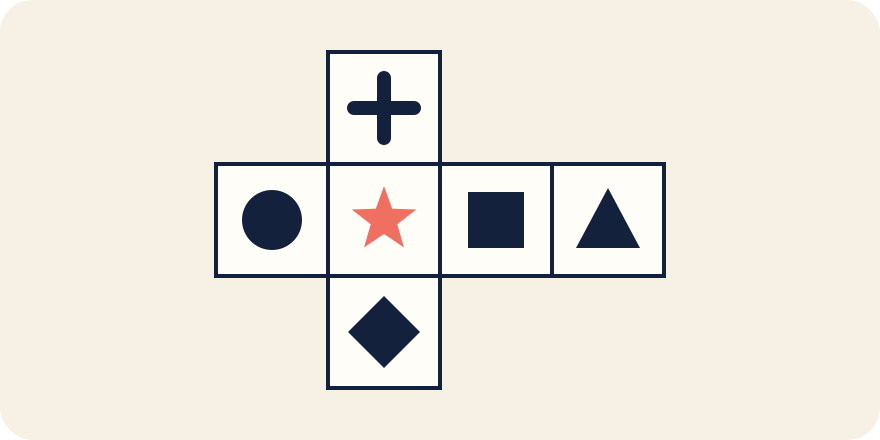
A flat net of six squares arranged in a cross. Reading across the row of four squares from left to right: a navy circle, a coral five-point star, a navy square, and a navy triangle. Directly above the coral star is a navy plus sign, and directly below the coral star is a navy diamond.
Method
Answer
Frequently asked questions
What is the fastest way to solve 11+ cube net questions?
Write down the three pairs of opposite faces using the skip-one-square rule, then cross out any 3D option that shows both faces of a pair together.
How do you tell which faces are opposite on a cube net?
Two faces separated by one square in a straight line are opposite; if there is no straight line of three, move one square along and one to the side (a knight's move) to find the opposite face.
What if two options still survive after checking opposite faces?
Pick one corner where three visible faces meet and check whether their symbols go clockwise or anticlockwise around that corner, and whether any directional symbol points toward the right neighbour.
Primary sources
- 11+ frequently asked questions
GL Assessment
Official provider page saying that local authorities or schools choose the subjects and question-type balance, may add questions, and remain the source for the exact local format.
Inside Plusling
Look closely at what changes in a visual puzzle.

See how the visual rule works after answering.

See practice history and questions to revisit.