
11+ Practice
11+ Non-Verbal Reasoning matrices: how to read rows and columns
Solve 11+ Non-Verbal Reasoning matrix questions by checking one visual feature across rows, a second feature down columns, and confirming both rules.
To solve an 11+ Non-Verbal Reasoning matrix question, track one visual feature at a time across the two complete rows, then track a second feature down the two complete columns, and combine both rules to build the missing tile before looking at the options. Trying to take in the whole grid at once overloads working memory and makes near-miss distractors look convincing.
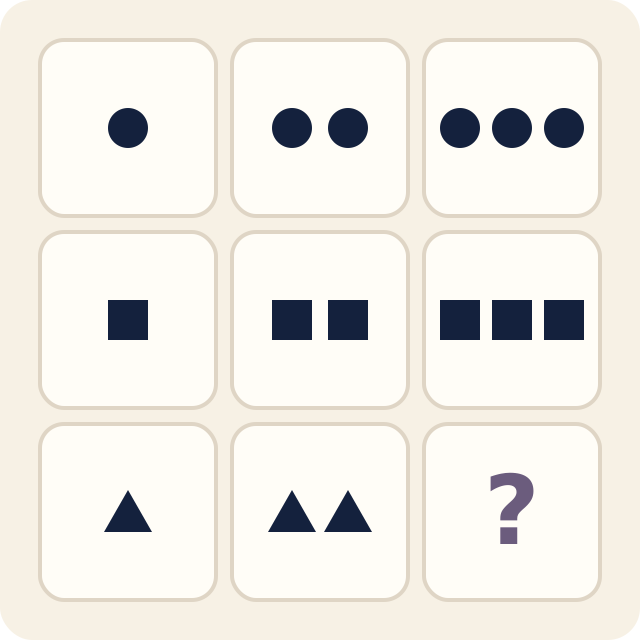
In 11+ Non-Verbal Reasoning, matrix grids test whether a pupil can isolate individual visual properties — shape, count, shading, size, rotation, and position — and verify how each property changes across a two-by-two or three-by-three grid [1] . Most errors happen when a child checks only the row containing the question mark and misses a second rule operating down the columns.
Step-by-step method
1. Read across the two complete rows to fix the first feature
Start with the two rows that have no missing tile (usually the top row and the middle row). Pick one clear feature — such as the outer shape or the direction an arrow points — and describe what happens from left to right in plain words:
- Same across the row: every panel in row 1 is a circle, every panel in row 2 is a square, so every panel in row 3 must be a triangle.
- Step change across the row: the shape rotates 90 degrees clockwise on each step from left to right, or gains one inner line on each step.
- One-of-each distribution (picture Sudoku): each row contains one circle, one square, and one triangle in some order, and each shading (solid, striped, white) appears once per row.
Write or whisper the prediction this gives you for the missing tile, and immediately cross out any answer option that breaks that single rule.
2. Read down the two complete columns to fix the second feature
Now look vertically down the two complete columns. Often the rows control one property (such as which shape appears) while the columns control another property (such as how many shapes appear, how they are shaded, or where a small marker dot sits). Check that your column rule holds in both complete columns, then apply it to the column containing the question mark.
3. Check overlays or combined tiles when shapes overlap
In harder three-by-three matrices, the third tile in a row or column is formed by combining the first two tiles:
- Addition: every line present in tile 1 or tile 2 appears in tile 3.
- Subtraction (keep only differences): lines that appear in both tile 1 and tile 2 cancel out, leaving only the lines that appeared once.
- Intersection (keep only shared parts): only the lines or shapes that appear in both tile 1 and tile 2 survive into tile 3.
Test your rule on one single line segment (such as the top edge or the diagonal) across the two complete rows before checking the whole figure.
Common traps and how to check
- Checking only the row with the question mark: Two answer options will almost always fit the bottom row on its own; the column rule is what separates the right answer from the trap.
- Confusing clockwise and anticlockwise rotation: Point a pencil along one flat edge or corner of the shape and turn the pencil physically from tile 1 to tile 2 to confirm the direction and angle of turn.
- Missing a shading swap in a distribution grid: When each row has one solid, one striped, and one white shape, check both the shape and the fill independently — a distractor often has the right shape with the wrong fill.
- Looking at the whole compound diagram in overlay grids: Never try to overlap two complex diagrams in your head. Pick one corner or one line segment and trace what happens to that piece alone.
How to practise this question type at home
Sit beside your child with four or five matrix questions and ask them to state two separate sentences before pointing to an option: “Across the rows, the rule for [feature A] is…” and “Down the columns, the rule for [feature B] is…” Naming the two rules aloud builds the habit that prevents hasty guesses.
To practise interactive Non-Verbal Reasoning questions with clear worked explanations, start a short session below.
Worked static example
Check the row rule and the column rule separately
Question
Text or spoken equivalent
A three-by-three grid of panels. Row one has one navy circle, then two navy circles, then three navy circles. Row two has one navy square, then two navy squares, then three navy squares. Row three has one navy triangle, then two navy triangles, and the third panel is a question mark.
Method
Answer
Frequently asked questions
What is a matrix question in 11+ Non-Verbal Reasoning?
A 2×2 or 3×3 grid of diagrams with one cell missing; the rule works across rows, down columns, or both.
Should my child check rows or columns first?
Check rows first for one feature (such as shape), then check columns for a second feature (such as count, shading or rotation), and confirm both on the two complete rows and columns.
What if nothing is being added across the row?
Many 3×3 grids are distribution grids where each row and column contains one of each shape, shading and orientation, like a small picture Sudoku.
Primary sources
- 11+ frequently asked questions
GL Assessment
Official provider page saying that local authorities or schools choose the subjects and question-type balance, may add questions, and remain the source for the exact local format.
Inside Plusling
Look closely at what changes in a visual puzzle.

See how the visual rule works after answering.

See practice history and questions to revisit.