
11+ Practice
11+ Non-Verbal Reasoning odd one out: how to test a shared rule
Solve 11+ Non-Verbal Reasoning odd-one-out questions by stating a rule that holds across four tiles at once rather than picking one unusual shape.
To solve an 11+ Non-Verbal Reasoning odd-one-out question, never ask “Which tile looks different?” — instead ask “What exact rule is true of four of these tiles at the same time?” Question writers deliberately include a decoy tile with a one-off shape or size to catch children who pick the first panel that stands out visually.
In 11+ Non-Verbal Reasoning, classification and odd-one-out questions test whether a child can look past surface variety (different angles, sizes, or outer shapes) and identify a deeper structural rule shared by four out of the five figures [1] . Once your child learns to state the shared four-tile rule in a complete sentence, decoy options lose their power.
Step-by-step method
1. Scan all five tiles for one feature at a time
Instead of staring at tile A and comparing it as a whole picture with tile B, run a quick checklist across all five tiles (A, B, C, D, E) one feature at a time:
- Count: number of outer sides, inner shapes, dots, lines, or intersections.
- Relationship between two counts: for example, dots equal sides, inner shape has one fewer side than outer shape, or number of stripes is always odd.
- Shading and line style: how solid, striped, and white fills are paired, or whether solid and dashed lines swap places.
- Position and overlap: which shape sits in front, whether a marker touches a corner or a flat edge, or whether an arrow points toward a specific symbol.
- Rotation vs reflection (chirality): whether four tiles are simple rotations of the same figure while the fifth has been flipped over like a mirror image.
2. Write small numbers under each tile when counting
Whenever a puzzle includes polygons, dots, hatching lines, or crossing bars, jot the two counts underneath each letter (3/3, 4/4, 5/5, 4/3, 3/3). Seeing the numbers written down makes a relationship between two features jump off the page in seconds, whereas keeping five pairs of numbers in your head invites a slip.
3. State the four-tile rule in one sentence to verify your choice
Before marking the answer sheet, finish the sentence: “Tiles __, __, __ and __ all have…, whereas tile __ has…” If your sentence only describes why one tile looks strange (“C is the only pentagon”), check whether the other four tiles actually share a tighter rule (for example, in our worked example above, A, B, C, and E all have the same number of dots as sides, which proves C belongs to the group and D is the true odd one out).
Common traps and how to check
- Falling for the “only one of that shape” decoy: If three tiles are triangles, one is a square, and one is a pentagon, the shape alone cannot be the rule because neither the square nor the pentagon leaves four matching tiles. Look for a rule linking the outer shape to what is inside it.
- Missing a mirror flip (reflection) among rotated shapes: When all five tiles have the exact same parts and counts, pick a landmark (such as a black dot) and read the other features going clockwise around the shape. Four tiles will read in the same clockwise order; the reflected odd one out will read in the reverse order.
- Ignoring overall size changes: In most Non-Verbal Reasoning questions, rotating a shape or making the whole group slightly larger or smaller does not break the rule unless size is specifically paired with another feature (such as “the smaller shape is always shaded”).
How to practise this question type at home
When reviewing odd-one-out questions with your child, cover the answer key and ask them to prove why the other four tiles belong together. If they can name the shared rule clearly, they have mastered the question even before checking the mark scheme.
To try interactive Non-Verbal Reasoning questions with worked explanations right away, start a short session below.
Worked static example
Look for a rule linking two features inside each tile
Question
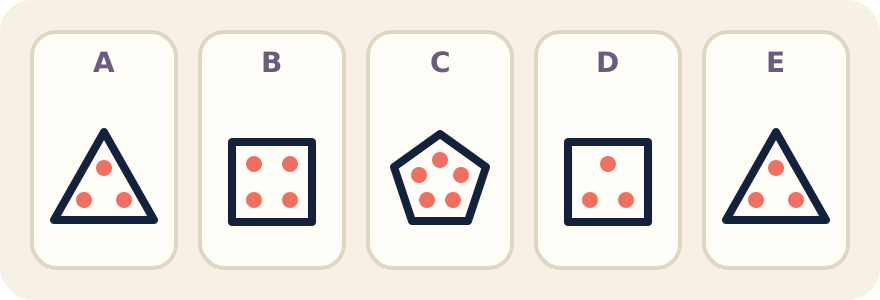
Text or spoken equivalent
Five panels labelled A to E. Panel A shows an outline triangle containing three coral dots. Panel B shows an outline square containing four coral dots. Panel C shows an outline pentagon containing five coral dots. Panel D shows an outline square containing three coral dots. Panel E shows an outline triangle containing three coral dots.
Method
Answer
Frequently asked questions
How do you solve 11+ odd-one-out shape questions?
State a rule that is true of four tiles at once, not just a detail that makes one tile look unusual.
Why do two answers sometimes both look like the odd one out?
Because a single-feature observation (such as “the only pentagon”) is weaker than a relationship that holds across four tiles (such as “dots equal sides”).
Which features should a child check first?
Number of sides, number of inner elements, shading, line style, symmetry and direction of rotation (clockwise vs anticlockwise order of parts).
Primary sources
- 11+ frequently asked questions
GL Assessment
Official provider page saying that local authorities or schools choose the subjects and question-type balance, may add questions, and remain the source for the exact local format.
Inside Plusling
Look closely at what changes in a visual puzzle.

See how the visual rule works after answering.

See practice history and questions to revisit.